Click me to go home |
|
|
Report from the
Native American Times
Animal rights group wants to give doomed horses to tribes
Idea latest in furor over controversial legislationSam Lewin 1/26/2005
An animal rights group hopes to muster support to defeat legislation that they say would result in thousands of wild horses being used as food for Europeans. Rather, the group would like to give those horses to Indian tribes.
The controversy started when Sen. Conrad Burns, R-Mont., sponsored legislation that reversed a longstanding Bureau of Land Management law. For years the BLM required people adopting wild horses to prove over the course of a year that they could adequately care for them before the agency would grant legal ownership. Burns' legislation allows the bureau to sell horses that are 10 or older, or that have been unsuccessfully offered for adoption three times, without the waiting period.
The law outraged many who worried that the horses could end up in countries like France and Belgium where horse steaks are considered a delicacy.
Burns has defended the measure, saying it is necessary to combat unchecked breeding.
"We've got to get the number of animals down to appropriate management levels and keep them there, but do it in a way that doesn't bankrupt us,'' he said.
Rep. Nick J. Rahall, D-WV, this week introduced legislation to put the waiting period back in place.
"The current slaughter policy does not acknowledge the fact that humane alternatives exist and federal agencies have the authority to carry out such actions such as adoption, sterilization, relocation, and placement with qualified individuals and organizations. To suggest that an acceptable solution to a federal agency's management dilemma is commercial slaughter is an irresponsible approach to our public lands and the wildlife that roam them," Rahall said. "Very few icons of the West remain, and wild horses are certainly a symbol of the frontier era and our nation's spirit. To allow them to be slaughtered without exhausting all other options, such as adoption, is an affront to our history."
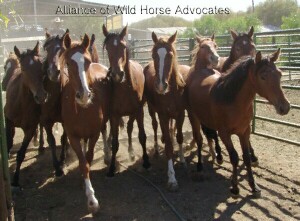
The Alliance of Wild Horse Advocates, comprised of over 40 wild horse and burro advocacy groups from dozens of states, is encouraging people to support Rahall's legislation.
"We commend [him] for introducing this bill. He has taken an important step in the history of our country because, if this law is not changed, America could lose its wild horses forever. We will not allow our wild horses to be slaughtered so they can be served for dinner in France, or anywhere," said Willis Lamm, an alliance member.
Lamm appears not to be exaggerating.
"You may want to try a nice juicy horse steak in one of the specialized restaurants," touts a travel guide to Antwerp.
"The future of our country's wild horses and burros is in the hands of our elected leaders in Congress. Americans everywhere must let them know they support this bill. It puts the language back into the Wild Free-Roaming Horse and Burro Act as it once was and gives protection back to the wild horses and burros," said Karen Sussman, Chairperson of the alliance. "Wild horses and burros are the great symbol of our country and represent the freedom we so cherish. They must be protected from slaughter forever. This bill is the answer to our prayers."
The alliance has received support from the Great Plains Tribal Council and the Intertribal Council of Nevada.
Sussman said that she supports giving the horses to Native American tribes.
"Our motto is `Original Horses with Original People'" Sussman told the Native American Times. She plans on meeting with tribal leaders in Oklahoma soon to further discuss the possibility of adoption.
"We are going to ask the tribes to take some of them. We would give 30 to 80 horses to a tribe if they are willing to take them."
NTN Article#: 5881
For additional Native American news, please visit the Native American Times at www.nativetimes.com.